
Author Interview Series: MM Historical Romance Writer, Logan Sage Adams

I’ve only had the pleasure to work with Logan Sage Adams by developmentally editing their MM historical romance debut novel, Our Own Light, a Lambda Literary finalist for gay romance.
Fast forward nearly two years later, and Logan Sage Adams has added five other books to their published collection.
In this first author interview blog series, Logan Sage Adams discusses some of the other books they’ve published, challenges they’ve faced researching for historical accuracy, writing tips for historical writers, and so much more.
Also, stay tuned for a sneak peak into their upcoming novel!
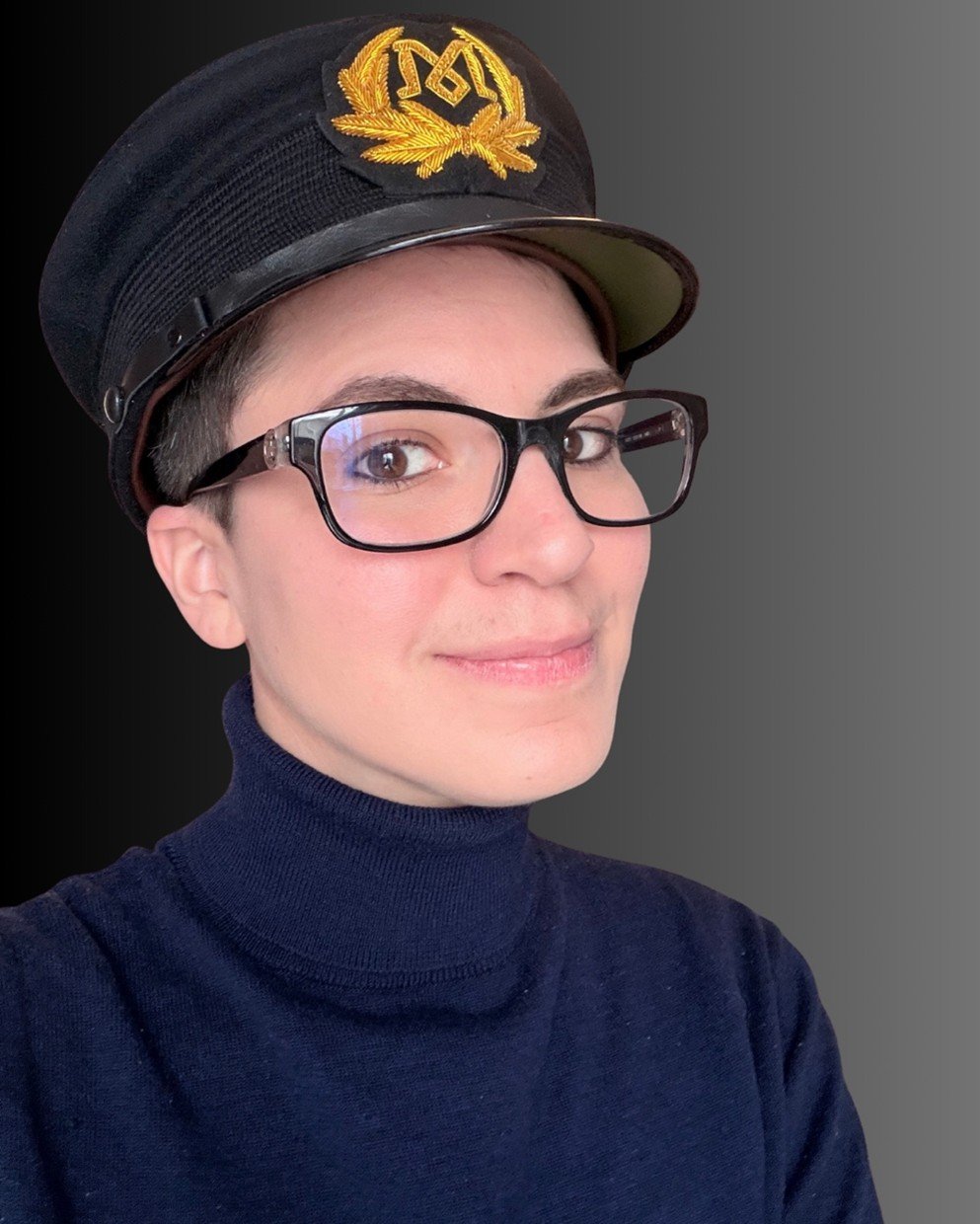
Q: How do you choose your historical moments to write a story? Please share any part of your writing or researching process.
Honestly, sometimes I just choose something based on a time period that interests me. Other times, I might get a spark of an idea from specific historical event that I learned about.
It really varies quite a lot!
When I wrote my first novel, Our Own Light, all I knew at the start was that I thought it could be interesting to write about blue collar workers back in the 1900s-1920s, and while researching, I stumbled across the Battle of Blair Mountain.
From there, the story really just took off!
Most of my stories start with that nugget of an idea, based on either an overall time period and location or a specific historical event.
Next, I find my main characters, which is a process that involves looking at old photographs until I come across one that feels like a character in my story. While I can picture many things in my head with ease (and often see things that I read and write as a movie that plays in my head), I struggle with faces, so finding a “face” for my character is a critical part of writing for me because it enables me to better see my character as I’m developing them.
Getting to know my characters in my head helps me flesh out the rest of the story.
I can find the themes from there or at the very least get a sense for a character’s inner struggle and the potential conflict(s) in the book.
Q: What’s your favorite aspect about marketing your books? Is there a part about marketing your books you don’t like?
Am I allowed to say that I hate marketing? I find it incredibly hard.
I’m an introvert and maybe modesty was sort of metaphorically hammered into me as a kid (or I’m just woefully insecure), but it’s difficult for me to shout about my books to the world.
I often feel like I’m bothering people by posting about them, even if it’s on my own Instagram account. I’m also often lounging around in pajamas and not camera-ready enough for many TikTok videos (so almost all of mine just feature a floating book and some words popping up on the screen to describe it).
I think the only thing I like about marketing is that it’s a wonderful excuse to commission too much artwork. I will forever support other creatives, and I love commissioning pieces to go with my books. I think it’s the part I look forward to the most about creating a book aside from researching (and sometimes writing – haha!).
“One of the most difficult things when writing historical romances is dealing with time period-appropriate vernacular. And location-specific vernacular, too! ”
Q: You have six published MM historical romances. That’s incredible! I’m always amazed when you come out with another historical MM romance story, because I know how incredible you are with making sure the historical accuracy is top-notch. Each book focuses on unique moments in history such as 1920s in West Virginia, the Gilded Age in Chicago, and the iconic Titanic. Therefore, what has been your favorite historical moment to research? How did you overcome challenges in writing characters or world-building to ensure authenticity and believability? Can you delve deeper into specific instances in your books?
It's extremely hard to choose! I absolutely loved researching the 1893 Chicago World’s Fair. I found it really fascinating! But I have to say that researching everything and anything related to the RMS Titanic has been my favorite, in part because there’s so much information out there.
Of course, that makes it tricky too, because there’s still a lot about Titanic, even with regard to her central propeller.
Did she have a three-bladed central propeller or four?
So, you can imagine that researching was at times like drinking from a firehose.
But so much fun.
I could research that ship for forever. And, well, I probably will, on and off!
One of the most difficult things when writing historical romances is dealing with time period-appropriate vernacular. And location-specific vernacular, too! I’m always coming across a saying or word that didn’t exist during the time I’m writing about. Sometimes I ignore it and include the word (or phase) but many times, I try to come up with an alternative.
I think the best example of this was for Ourselves and Immortality, which is a story about a shy mortician (who is autistic) and a charming con man. It’s set in 1902 in Philadelphia. Something that was important to me while writing this book was to show John, the mortician, as someone who was very empathetic. Despite what some may think about autistic individuals, many or most are most definitely empathetic (or even hyper-empathetic).
But while writing, I discovered that the word “empathy” didn’t really exist in 1902. At least, not how it’s used today. It only came to mean a vicarious sharing of emotion in 1908.
So, I improved and called what John was experiencing so much of “painful sympathy.” I think that more accurately described his experience anyway, so maybe it was a bit serendipitous that I randomly chose 1902 as the year for that novel, rather than 1908 or later.
Ensuring that I (mostly) use language that the characters would use, even when writing in third person, helps ground the story in the setting and time period. It’s a tricky yet important part of writing historical for sure.
Q: Across the Living Infinite is a new MM historical romance release, which is about two men finding romance on Titanic! That sounds so exciting! Can you tell us more about what the story is about, what inspired you to write this story, and what writing challenges you might have faced?
Across the Living Infinite is a love story between a first-class passenger and a first-class steward. It’s a whirlwind romance for sure, and it’s one that led to a lot of character growth, especially for first-class passenger Cassian Penn Livingston. Even though it’s a story that takes place during a tragic historical event, it has a lot of hope and joy in the end, though I did not shy away from the absolute devastation and terrible loss of life that occurred when the ship sank.
As for inspiration, that came from friends of mine (some writers, some readers) who reached out to me and flat-out asked if I’d ever consider writing a romance set aboard the RMS Titanic.
I was hesitant at first.
After all, not only was it a huge tragedy, but I was afraid that I’d mess it up somehow. Out of every shipwreck I can think of from the 20th century, the RMS Titanic has to be one of the most well-known, especially in the US.
And therefore, there’s a lot of information out there surrounding the ship (and a lot of Titanic fanatics out there!). Sifting through the vast amount of information that’s available was a challenge in and of itself, and eventually, I had to commit to a particular source of information for certain elements surrounding the sinking, such as the lifeboat launch times, just for consistency’s sake.
Still, writing it was such a rewarding experience. It rekindled my love for the ship and jumpstarted my interest in ocean liners and lake freighters. I really hope that folks will enjoy the story I was able to craft!
Q: You were a finalist for the 2025 Lambda Literary Awards for Our Own Light in gay romance, your debut novel your published in 2024. You also presented there. Can you tell us anything about that whole experience?
If I could describe my experience in one word, it would be: humbling.
I felt truly honored to be a finalist with such other wonderful authors.
I was given the opportunity to be on a panel talking about queer resistance in literature and found myself in awe of the other panelists many times. Everyone’s responses were so insightful and poignant to all of the questions we were asked about our books or about queer resistance overall.
I’ll forever be grateful to be awarded the chance to participate on that panel, and I’m still honestly floored that Our Own Light was a finalist!
Q: What writing advice do you have for aspiring writers writing their first MM romance or MM historical romance?
With regard to the historical aspect, I think my advice is to research hard and research well.
When writing the story, if you have the opportunity to insert something specific to the setting or time period, do it, and check absolutely everything.
Going to have your character leave on a hunting trip? Check the local laws at the time that your story was taking place as well as what flora and fauna they might see on their outing.
Is your character getting ready for the day? Confirm what kind of clothing was typically worn by someone of their stature, and while you’re at it, do a bit of research into the popular personal care products too.
All of these kinds of details can make your readers feel immersed in the story. And they’re a heck of a lot of fun to learn about too.
I think my other piece of advice is that you’re going to get things wrong.
Even if you hire a fantastic copy editor, you’re probably going to make a mistake. But don’t let that stop you from writing historical romances.
Give it your all, hope for the best, and remain committed to producing the best story that you can.
Q: Are you writing a new historical MM romance? If so, can you share any clues about the historical setting or characters?
Sure! I write ahead and release out of order, so the one I’m writing right now might not come out until 2027 (early in the year).
It’s set aboard a lake freighter in 1913 (perhaps that’s a clue about a historical event that happens during the book) and features a romance between the often-harsh first mate and a new member of the crew who soon becomes one of the ship’s wheelsmen. Both men have experienced significant loss in their lives and find comfort in the other.
I’m maybe 70% finished with my first draft, but I know it’ll need some revisions before it’s even close to ready to be shared with my editor, let alone the world!
Thank you so much for this wonderful author interview, Logan Sage Adams! It was a true honor working with you!
About Logan Sage Adams
Bio: Logan Sage Adams (she/they) is a Lambda Literary Award finalist who writes historical romances with plenty of sweetness, a little heartache, occasional humor, and hard-earned happily ever afters. Their work explores themes like healing from loss, finding the courage to fall in love, learning to love oneself, and overcoming trauma. Harnessing their love of learning, Logan writes rich, immersive stories with memorable characters and plenty of queer joy.
When she's not writing or reading, Logan can be found cooking, chatting with friends, working, and spending time with their supportive family.
Pronouns: they/she
________________________________________________________________________________________________________________________________________
Cover artist from book covers: Instagram